Amslux: the website behind an invite-only app for footballers.
Amslux is a private luxury app for professional footballers, covering fashion, watches, travel, dining and events. It had no website that matched the brand. We built its online presence, have looked after it for about two years, and the app has passed 4,000 installs from the website we built and look after.
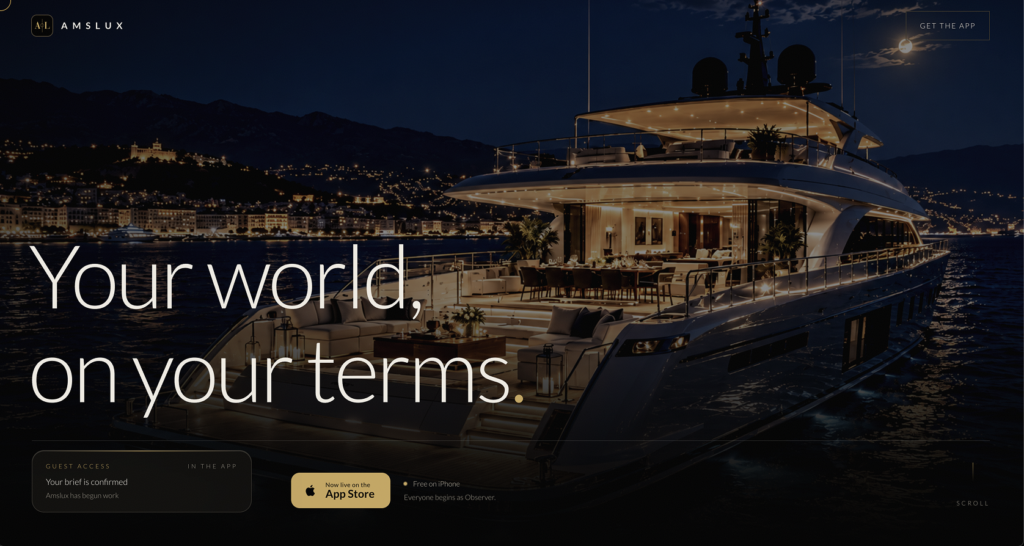
Live at amslux.app
A private world, built for a very small audience.
Amslux is an invite-only app for professional footballers. It covers fashion, watches, travel, dining and events in the cities where its members live, train and travel.
The audience is small and every member is valuable. These are people used to the best of everything. If the first thing they see looks cheap or unfinished, they don't download, and they rarely come back to give it a second look.
In one sentence: we gave a luxury app a website that looks and feels like the product, explains its membership clearly, puts the App Store one tap away, and we have looked after it for about two years, keeping it fast and in step with the app.
What was the starting point?
Amslux didn't have a website that matched the brand. For a luxury product aimed at a small, high-value audience, that's expensive. A weak first impression costs downloads, and there are only so many professional footballers to win over.
People also decide fast. Users often leave web pages within 10 to 20 seconds (Nielsen Norman Group, 2011). A footballer who hears about Amslux from a teammate and looks it up has a few seconds to feel that this is something worth joining.
Why does an app need a website at all?
Because almost nobody finds an app inside the App Store first. They hear about it in a dressing room, a group chat or a message, and then they look it up. The website is where that curiosity turns into a download, or doesn't. It also has to look right when someone shares the link in a message, before anyone even taps it.
What did "matching the brand" mean in practice?
- A premium, dark look that feels like the app, not like a template.
- A clear explanation of membership, because an invite-only product raises questions about who gets in and what each level means.
- No friction on phones, since that is where the app gets downloaded.
- Privacy taken seriously, because high-profile members expect it.
What we did, and didn't, build
We didn't build the Amslux app. App development isn't our trade. We built the online presence around it, and we look after the website that sends people to the App Store.
An online presence that feels like the app.
Six things, built once and then looked after for about two years.
A premium, dark look
A full online presence with a premium, dark design that matches the Amslux brand.
Four levels, clearly explained
Observer, Connected, Trusted and Influential, each one explained so members know where they stand.
One tap to the App Store
App Store links throughout, plus Apple's smart app banner for anyone visiting on an iPhone.
Polished link previews
When someone shares the site in a message or social app, it shows a proper title, image and description.
Privacy and consent
A privacy page and a consent banner for analytics, so visitors choose what is measured.
Two years of care
Hosting, security, backups and ongoing care, for about two years and counting.
Invite-only, but never confusing.
An invite-only product makes people curious about the rules. The site explains the four levels in order, so a new member understands where they start and what comes next.
Level names as shown on the Amslux site. As the app adds levels or changes them, we update the site to match.
From a shared link to a download, in as few taps as possible.
An app is downloaded on a phone, so the website has to work best there, often for someone who has just tapped a link a friend sent. So we built for that exact moment.
- Link previews that look polished when the site is shared in a message
- Apple's smart app banner, a small strip at the top of the page on iPhones that opens the App Store
- One-tap App Store links throughout the site, not just at the bottom
The drawing is an illustration of how these pieces work, not a screenshot.
Built once. Looked after ever since.
Stages in the order they happened, rather than exact dates. Most of this story is the quiet part: two years of keeping up.
An app without a website that matched it.
A luxury product for a small, high-value audience, with nowhere online that showed what it was really like.
A full online presence, premium and dark.
- The four membership levels explained
- App Store links throughout, and the smart app banner
- Link previews, a privacy page and a consent banner
New levels and cities, reflected on the site.
When the app changes, the website has to change with it. Otherwise a visitor reads one thing on the site and finds another in the app.
4,000+ installs, and still looked after.
Fast and up to date. The website keeps turning curious visitors into members.
Monday, 8:00
Hi, a quiet, safe week. One update to approve.
- Online all week, fast on phones
- App Store links and iPhone banner tested on a real iPhone
- Consent banner working, privacy page current
- Link preview checked in two messaging apps
- Needs you: the app's new city isn't on the site yet. We've drafted the text. Reply "yes" to publish.
- Add the new city once approved
- Check level descriptions match the app
- Test restore from backup
Names and numbers changed for illustration.
Fast, secure, and in step with the app.
Two years in, the job is less about building and more about keeping up. The app adds levels and cities. Phones and browsers change. Software needs updating. We keep checking that the website still tells the truth about the app, and still gets people to it in one tap.
- Speed on phones, where the download happens
- App Store links and the iPhone banner, tested
- Membership levels and cities, matched to the app
- Security, backups, updates, privacy page and consent banner
The website turns curious visitors into members.
Amslux has passed 4,000 app installs and keeps counting, with a website that looks like the product, explains the membership and makes downloading effortless.
This is the figure Amslux approved for this page. We don't publish member details, revenue or anything about who uses the app. For a private product, that discretion is part of the service.
A website isn't finished when it launches.
The biggest lesson from Amslux isn't the launch. It's the two years after. If your business changes, your website has to keep up.
You sell something premium
Jewelers, furniture makers, specialists. When quality is the product, the site has to show it.
Makers and specialistsPeople act somewhere else
A store, an app, a booking system. We make the jump there one tap, and check it works.
Fixes where visitors give upYour business keeps changing
New services, new prices, new places. We keep the site in step, and tested.
Safe updatesYou had a site built, then left
Many agencies build and move on. We stay, and show our work in a short Monday note.
Questions about this case study.
Something else? Ask in the chat, email hello@penguina.website or WhatsApp us.
Did Penguina build the Amslux app?
No. We don't build apps. We built Amslux's website and online presence, and we have looked after that website for about two years.
What is a smart app banner?
It's a small strip Apple lets websites show at the top of the page in Safari on iPhones and iPads. It names the app and offers to open it or get it from the App Store, without the visitor having to search.
What is a link preview, and why does it matter?
When you paste a website address into a message or social app, it often shows a small card with a title, picture and short description. If that card is set up properly, the link looks trustworthy. If not, it may show a blank box or the wrong picture. For a product that spreads by people sharing links, that card is the first impression.
Why does a website need a consent banner?
If a site measures visitors with analytics that use cookies or similar tools, privacy laws in places like the UK and EU generally require asking first. Amslux's site asks before measuring. We aren't lawyers, so for your own business we'd suggest checking the rules that apply to you.
Can you make my website look premium?
A full redesign isn't part of our monthly plans, so we'd quote it separately and you'd decide. Within your plan, we can still fix what makes a site feel cheap: slow pages, broken links, poor link previews and confusing layouts on phones.
How do you know the installs came from the website?
The 4,000+ figure is Amslux's own, and they approved how it's described on this page. We don't publish their data, and we don't claim credit for how people first heard about the app.
Sources for the figures on this page
Not sure where to start? Send us your website.
We look at it the way a customer would, find up to 3 real problems, and fix one of them free. No call needed.